
Global markets are shifting faster than ever, and investors searching for clear, Asia-focused insights need more than headlines—they need context, strategy, and actionable direction. This article delivers a sharp breakdown of today’s financial pulse across key Asian markets, highlighting emerging opportunities, risk factors, and portfolio positioning strategies that align with current global investment flows.
Whether you’re refining allocations or exploring new regional exposure, we connect real-time market movements with practical trading frameworks, including modern portfolio theory explained exactly as it is given, so you can balance risk and return with greater precision. Our analysis draws on current market data, cross-border capital trends, and established portfolio optimization principles to ensure every insight is grounded in evidence—not speculation.
By the end, you’ll have a clearer understanding of where momentum is building, how macro forces are shaping Asia-centric investments, and how to adjust your strategy with confidence in today’s evolving financial landscape.
Maximizing Returns While Minimizing Risk: A Timeless Challenge
Every investor wrestles with the same question: how do you grow wealth without blowing up your portfolio? Too often, decisions are driven by headlines or “hot” tips (remember the meme-stock frenzy?), resulting in portfolios that swing wildly. In fact, DALBAR studies show the average investor underperforms the market due to emotional decisions.
This is where modern portfolio theory explained becomes powerful. Developed by Harry Markowitz (Nobel Prize, 1990), it proves mathematically that diversification can optimize returns for a given level of risk.
Key principles include:
- Diversification across uncorrelated assets
- The efficient frontier framework
- Risk measured by standard deviation
For example, combining Asian equities with global bonds has historically reduced volatility while preserving returns.
A Portfolio Is a Team, Not a Solo Act
At its heart, modern portfolio theory explained one deceptively simple idea: a portfolio is more than a random pile of stocks. It’s a team. And just like in sports, stacking a roster with only star scorers (looking at you, all-tech investors) doesn’t guarantee you’ll win championships.
Instead, the magic lies in relationships. Specifically, correlation—how assets move in relation to one another. If two stocks zig and zag at the same time, you’re basically doubling down on drama. However, if one zigs while the other chills, their low correlation can smooth the ride. That’s the secret sauce.
Moreover, MPT quantifies risk using volatility, meaning price swings aren’t just background noise—they’re center stage. Traditionally, investors obsessed over returns. Yet returns without considering risk are like speed without brakes (thrilling, briefly).
So rather than judging investments in isolation, MPT asks a better question: how does this asset behave inside the group? Because harmony, not hype, builds resilient portfolios.
The Three Pillars of Portfolio Optimization
Portfolio optimization sounds complex (and, admittedly, a little Wall Street-y), but it rests on three practical pillars you can apply immediately.
Pillar 1 – Diversification: The Only Free Lunch
Diversification means more than owning 25 different tech stocks. True diversification involves spreading investments across asset classes—such as domestic equities, international bonds, and real estate—that respond differently to the same event.
Think of a street vendor who sells both umbrellas and sunglasses. When it rains, umbrellas fly off the shelf. When the sun blazes, sunglasses sell instead. Either way, revenue flows. That’s diversification in action.
The key concept here is correlation, which measures how assets move in relation to one another. Assets with low or negative correlation don’t rise and fall together. According to research published in the Journal of Finance, combining low-correlation assets can significantly reduce portfolio volatility over time.
Practical tip: Review your holdings and group them by asset class. If most react similarly to interest rates or economic news, you may not be as diversified as you think.
Pillar 2 – The Efficient Frontier: The Optimal Trade-off
Next, imagine a graph plotting risk (horizontal axis) against return (vertical axis). The Efficient Frontier is the upward-sloping curve representing portfolios that deliver the highest expected return for a given level of risk.
Any portfolio below that curve is inefficient—it either takes on too much risk for its return or earns too little for the risk assumed.
Your goal? Build a portfolio that sits on the frontier.
Step-by-step:
- Estimate expected returns for each asset class.
- Measure volatility and correlation.
- Use portfolio tools or software to identify optimal weightings.
It’s less “throw darts at a board” and more “Moneyball with spreadsheets.”
Pillar 3 – Risk-Return Relationship
In modern portfolio theory explained, risk is typically measured by standard deviation, which captures how widely returns fluctuate around the average.
Higher risk should mean higher expected return. If it doesn’t, the investment may not justify its volatility.
This framework lets you quantify trade-offs. For example, if adding emerging market equities increases expected return by 1% but raises volatility by 4%, you must decide whether that exchange fits your tolerance.
Ultimately, optimization isn’t about chasing returns. It’s about intentionally balancing risk and reward—so your portfolio works in both sunshine and storms.
How MPT Shapes Real-World Investment Strategies
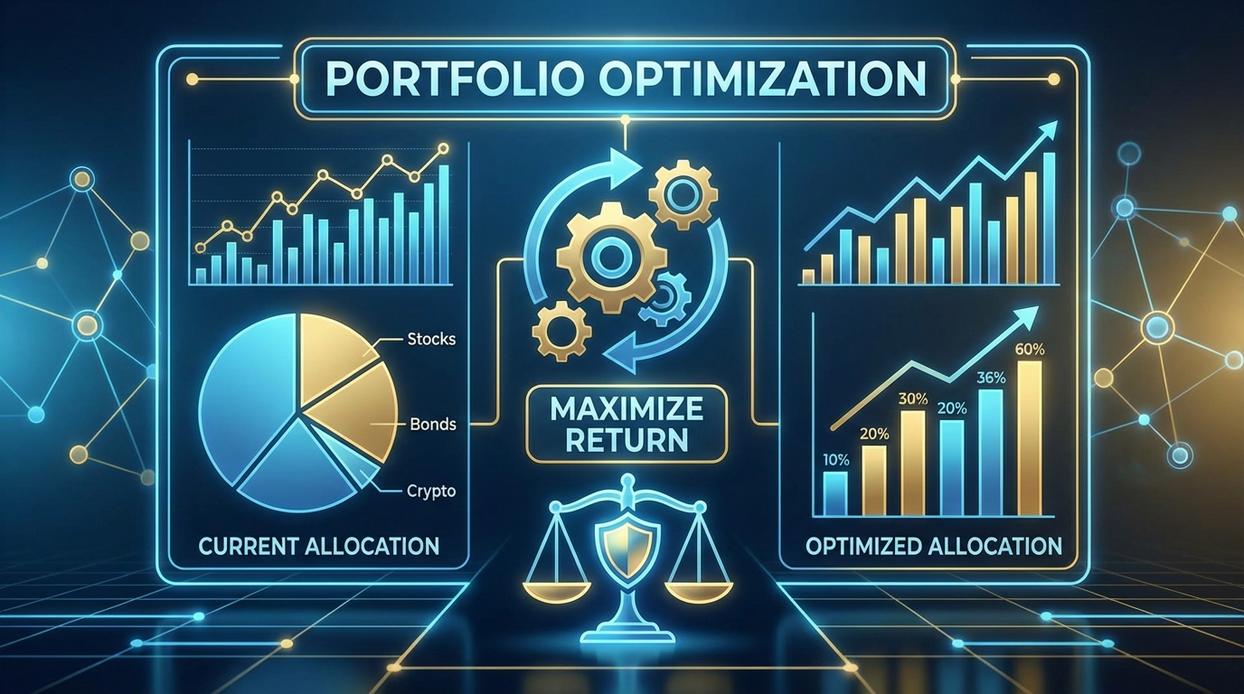
Modern portfolio theory explained in plain English is simple: don’t put all your eggs in one basket—especially if those baskets move differently. In practice, this thinking drives strategic asset allocation, the long-term mix of assets in a portfolio.
Take the classic 60/40 portfolio: 60% stocks, 40% bonds. Historically, stocks and bonds have shown low correlation (their prices don’t move in lockstep), which helps smooth returns during volatility (like a financial shock absorber). When stocks dip, bonds have often held steadier, reducing overall portfolio swings (Source: Vanguard research on asset allocation).
The Rise of Automated Investing
Today, robo-advisors and target-date funds automate this logic. Based on your age and risk tolerance, they place you on an “efficient frontier” (the set of portfolios targeting the highest expected return for a given level of risk) and rebalance regularly. If you’ve ever invested in a 2045 retirement fund, you’re already using MPT in action.
For a hands-on approach, follow these steps:
- Assess your risk tolerance. Can you handle a 20% drop without panic selling?
- Choose low-correlation assets. Think stocks, bonds, real estate, or commodities.
- Allocate and rebalance. Use guides like how to rebalance a portfolio in changing market conditions.
Pro tip: Revisit allocations annually—markets change, and so should you.
Is Modern Portfolio Theory Still Modern? A Critical Look
Modern portfolio theory explained in textbooks sounds airtight. Use historical data, optimize risk, diversify broadly—done. However, critics argue that relying on past returns and correlations assumes tomorrow will behave like yesterday. In fast-moving markets shaped by AI, geopolitics, and sudden policy shifts, that assumption can crack.
Then there’s the belief in rational investors. Behavioral finance shows we’re not robots; fear and greed often drive decisions (just think of meme stock mania). If markets reflect emotion, purely mathematical models may miss the human factor.
Most concerning, during “Black Swan” events—rare, extreme shocks—correlations can spike toward 1. In plain terms, everything falls together. Diversification, the crown jewel of MPT, may offer less protection right when you need it most.
So what’s in it for you? Understanding these weaknesses helps you stress-test your portfolio, question assumptions, and build flexibility beyond static models. In other words, you’re not abandoning theory—you’re upgrading it.
From Framework to Reality
Modern Portfolio Theory isn’t a crystal ball (sorry, Doctor Strange fans). But modern portfolio theory explained pushes investors beyond gut picks into structured thinking.
- Diversify across assets.
- Measure risk, not vibes.
- Align holdings with goals.
Like assembling the Avengers, balance beats bravado consistently.
Position Your Portfolio for Smarter Growth
You came here to gain clarity on today’s fast-moving Asian markets and sharpen your trading and investment strategy. Now you have a clearer view of the financial pulse driving global opportunities, the regional forces shaping Asia-centric markets, and how disciplined portfolio optimization can protect and grow your capital.
Markets don’t wait. Volatility, policy shifts, and capital rotations can quickly erode returns if your strategy isn’t structured around risk management and diversification. That’s why applying modern portfolio theory explained in practical, real-world terms is so critical—it helps you balance risk and reward instead of chasing performance blindly.
The next step is simple: put these insights into action. Reassess your asset allocation, stress-test your portfolio against current macro trends, and align your trades with data—not emotion.
If you’re serious about reducing downside risk while capturing high-growth opportunities, now is the time to act. Get expert-backed market updates, proven trading frameworks, and Asia-focused investment intelligence designed to optimize your portfolio in any market condition. Start refining your strategy today and take control of your financial edge.